

As a well - established supplier of Crawler Shot Blasting Machines, I've witnessed firsthand the critical role these machines play in various industries. Shot blasting is a surface treatment process that uses abrasive materials to clean, strengthen, or polish metal surfaces. A Crawler Shot Blasting Machine is particularly useful for treating small to medium - sized workpieces, as it can efficiently and uniformly blast the surface of the parts. However, ensuring the shot blasting quality is of utmost importance. In this blog, I'll share the inspection methods for the shot blasting quality of a Crawler Shot Blasting Machine.
Surface Cleanliness Inspection
The primary purpose of shot blasting is to remove contaminants such as rust, scale, and old paint from the workpiece surface. One of the most straightforward ways to inspect surface cleanliness is through visual inspection. After the shot blasting process, the workpiece should have a uniform, clean appearance. Any remaining rust, scale, or paint indicates an inadequate shot blasting process.
For a more precise assessment, we can use the Swedish Standard SIS 05 5900 or the American Society for Testing and Materials (ASTM) D 4285 standards. These standards classify the surface cleanliness levels into different grades. For example, in the SIS 05 5900 standard, Sa 1 represents light blast cleaning, Sa 2 is thorough blast cleaning, Sa 2.5 is very thorough blast cleaning, and Sa 3 is blast cleaning to pure metal. By comparing the blasted surface with the standard reference photos, we can determine the cleanliness grade of the workpiece.
Surface Roughness Inspection
Surface roughness is another crucial parameter in shot blasting. The right surface roughness can improve the adhesion of coatings, enhance the fatigue resistance of the workpiece, and provide better friction characteristics. There are several methods to measure surface roughness.
The most common method is using a surface roughness tester. This device measures the vertical deviations of the surface profile. The tester has a stylus that moves across the surface of the workpiece, and it records the peaks and valleys of the surface. The measured values are then used to calculate parameters such as Ra (arithmetical mean deviation of the profile), Rz (average maximum height of the profile), etc.
Another method is the comparison method. We can use a set of standard surface roughness specimens with known roughness values. By visually and tactilely comparing the blasted workpiece surface with these specimens, we can estimate the surface roughness. However, this method is less accurate than using a surface roughness tester.
Residual Stress Inspection
Shot blasting can induce residual stress on the workpiece surface, which can have a significant impact on the mechanical properties of the workpiece. Compressive residual stress can improve the fatigue life and stress - corrosion cracking resistance of the workpiece, while tensile residual stress can have the opposite effect.
X - ray diffraction is a widely used method for measuring residual stress. This technique is based on the principle that the lattice spacing of a crystal changes under stress. By measuring the change in the diffraction angle of X - rays scattered from the crystal lattice of the material, we can calculate the residual stress.
Ultrasonic testing can also be used to measure residual stress. The velocity of ultrasonic waves in a material is affected by the residual stress. By measuring the change in the ultrasonic wave velocity, we can estimate the residual stress. However, ultrasonic testing is more suitable for measuring the average residual stress in a relatively large volume of the material.
Abrasive Quality Inspection
The quality of the abrasive used in the Crawler Shot Blasting Machine directly affects the shot blasting quality. The abrasive should have the right hardness, size, and shape.
Hardness can be measured using a hardness tester. For example, a Rockwell hardness tester or a Vickers hardness tester can be used to measure the hardness of the abrasive particles. The abrasive should be hard enough to remove the contaminants on the workpiece surface but not too hard to cause excessive damage to the workpiece.
The size of the abrasive particles can be determined using a sieve analysis. We pass the abrasive through a series of sieves with different mesh sizes and measure the amount of abrasive retained on each sieve. This allows us to determine the particle size distribution of the abrasive.
The shape of the abrasive particles can be observed using a microscope. Spherical or near - spherical abrasive particles are generally preferred as they can provide a more uniform shot blasting effect.
Inspection of Workpiece Dimensions
Shot blasting can sometimes cause a slight change in the dimensions of the workpiece, especially for thin - walled or precision parts. Therefore, it is necessary to measure the dimensions of the workpiece before and after shot blasting.
We can use measuring tools such as calipers, micrometers, and coordinate measuring machines (CMM) to measure the dimensions of the workpiece. Any significant change in the dimensions may indicate an improper shot blasting process, such as excessive abrasive flow rate or incorrect blasting pressure.
Inspection of Shot Blasting Machine Performance
In addition to inspecting the workpiece, it is also important to inspect the performance of the Crawler Shot Blasting Machine itself.
The abrasive flow rate is a critical parameter. We can measure the abrasive flow rate by collecting the abrasive discharged from the machine within a certain period and weighing it. An unstable or incorrect abrasive flow rate can lead to uneven shot blasting results.
The blasting pressure also affects the shot blasting quality. We can use a pressure gauge to measure the blasting pressure at the nozzle. The blasting pressure should be adjusted according to the type of workpiece and the required shot blasting effect.
The rotation speed of the crawler in the Crawler Shot Blasting Machine is another important factor. A proper rotation speed ensures that the workpieces are uniformly exposed to the abrasive stream. We can use a tachometer to measure the rotation speed of the crawler.
In conclusion, ensuring the shot blasting quality of a Crawler Shot Blasting Machine requires a comprehensive inspection of the workpiece surface cleanliness, surface roughness, residual stress, abrasive quality, workpiece dimensions, and machine performance. By using the appropriate inspection methods and regularly monitoring these parameters, we can ensure that the shot blasting process meets the required standards and produces high - quality workpieces.
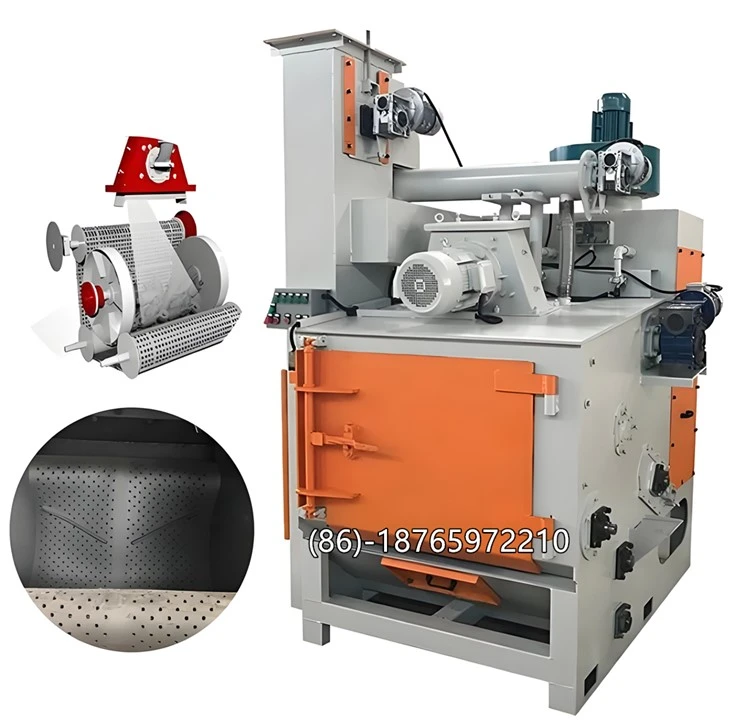

If you are in the market for a Crawler Shot Blasting Machine or need more information about shot blasting quality inspection, we are here to help. We offer a wide range of shot blasting machines, including Tumble Shot Blast Machine, Barrel Shot Blasting Machines, and Crawler Shot Blasting Machine for Valve Cleaning. Contact us to discuss your specific requirements and start a procurement negotiation.
References
- ASTM D 4285 - Standard Practice for Determining Degree of Contamination of Abrasive Blast - Cleaned Metal Surfaces
- SIS 05 5900 - Preparation of steel substrates before application of paints and related products. Visual assessment of surface cleanliness
- ISO 4287 - Geometrical product specifications (GPS) - Surface texture: Profile method - Terms, definitions and surface texture parameters